
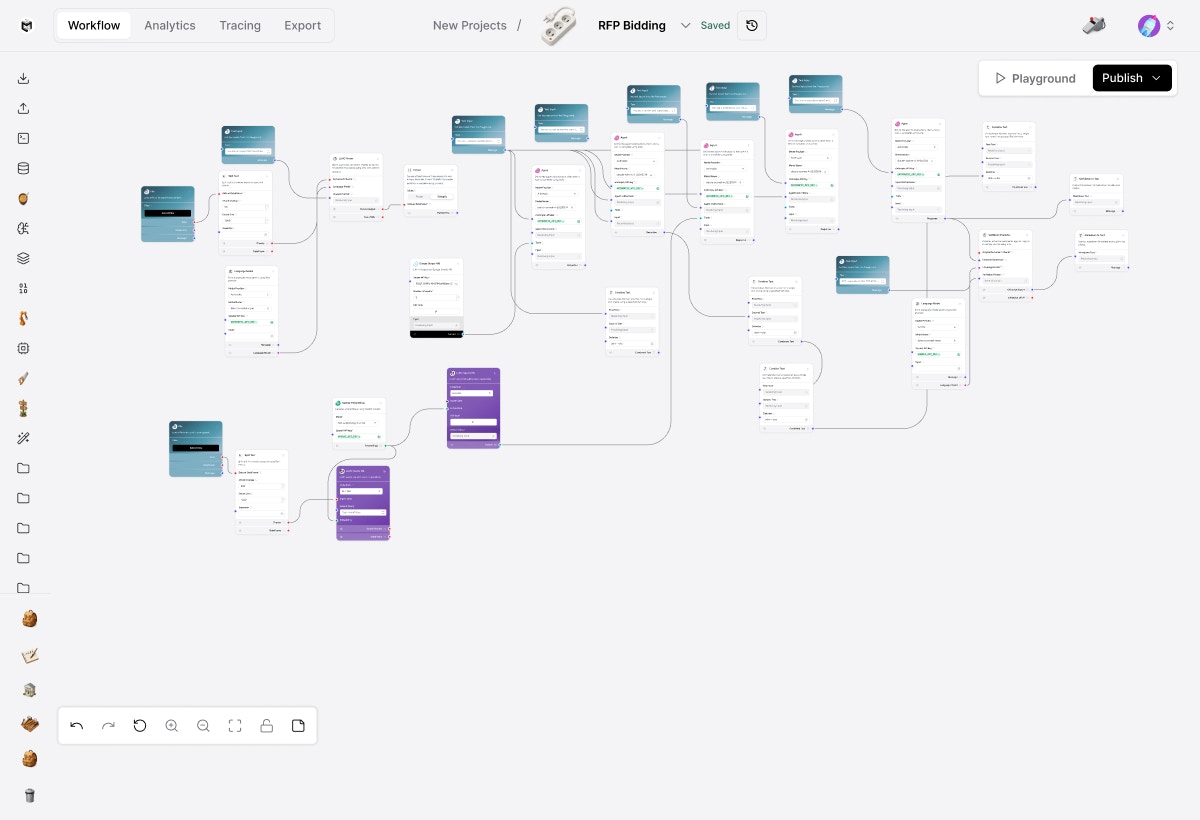
Workflow Steps & Components
1. Document Loading & Preprocessing
Component: File
Purpose: Loads RFP documents (PDF, DOCX, TXT, etc.) for processing User Configurations:- File upload or server file path
- Processing concurrency settings
- File type validation
Component: Split Text
Purpose: Splits large RFP documents into manageable chunks for processing User Configurations:- Chunk size (default: configurable)
- Chunk overlap
- Separator settings
2. Structured Data Extraction
Component: LLMC Parser
Purpose: Uses an LLM to extract structured data from RFP document chunks Inputs:- Document chunks (from Split Text)
- Language Model (for parsing)
- Custom extraction prompt
- Custom prompt for data extraction
- Batch size for processing
- Language model selection
Component: Language Model
Purpose: Provides the language model for parsing and analysis Connected To:- LLMC Parser for initial extraction
- Validation Evaluator for quality checks
- Model provider (OpenAI, Anthropic, etc.)
- API keys
- Temperature and other model parameters
Component: Parser
Purpose: Formats extracted structured data into a readable text format Inputs:- Parsed data from LLMC Parser
- Template pattern for formatting
- Template pattern (e.g., “Text: text”)
- Separator for multiple items
3. Multi-Agent Analysis Pipeline
The workflow uses five specialized AI agents, each equipped with web search capabilities via Google Serper API:Component: Google Serper API
Purpose: Provides web search functionality to all agents User Configurations:- Serper API Key
- Number of search results
Agent 1: Domain Classification Agent
Component: Agent
Purpose: Analyzes and classifies the RFP project domain Tasks:- Identifies primary and secondary business domains (Construction, IT Services, Healthcare, etc.)
- Calculates capability match percentage based on work requirements
- Identifies required competencies and skills
- Parsed RFP data (from Parser)
- System prompt for domain classification
- Google Serper API tool
- Output: JSON with domain classification, capabilities match, competencies, and research insights
Agent 2: Cost Estimation Agent
Component: Agent
Purpose: Provides detailed cost estimates for the project Tasks:- Estimates cost range (low/mid/high scenarios)
- Provides detailed cost breakdown by categories (labor, materials, equipment, etc.)
- Calculates margin analysis with profit targets
- Identifies key cost drivers
- Assesses cost-related risks
- Researches current market rates via web search
- Parsed RFP data
- System prompt for cost estimation
- Google Serper API tool
- Current date tool
Agent 3: Vendor & Subcontractor Matching Agent
Component: Agent
Purpose: Identifies necessary vendors and subcontractors Tasks:- Identifies required vendor categories based on project scope
- Assesses vendor availability in project location
- Identifies potential vendor gaps or challenges
- Notes geographic and logistical considerations
- Provides vendor sourcing recommendations
- Research certified subcontractors and suppliers via web search
- Parsed RFP data
- System prompt for vendor matching
- Google Serper API tool
- Current date tool
Agent 4: Compliance & Risk Assessment Agent
Component: Agent
Purpose: Analyzes regulatory requirements and project risks Tasks:- Identifies regulatory and compliance requirements
- Assesses compliance complexity and timeline
- Identifies and categorizes project risks (technical, financial, operational, regulatory)
- Calculates overall risk score
- Provides risk mitigation strategies
- Researches current regulations and standards via web search
- System prompt for compliance assessment
- Google Serper API tool
- Current date tool
Agent 5: Final Proposal Agent
Component: Agent
Purpose: Combines all analyses into a comprehensive bidding proposal Inputs:- Combined outputs from previous agents
- System prompt for proposal generation
4. Data Aggregation & Validation
Component: Combine Text
Purpose: Combines outputs from multiple agents into unified text User Configurations:- Multiple text inputs from agents
- Separator settings
Component: Validation Evaluator
Purpose: Validates extracted summaries against original document chunks Tasks:- Compares extracted content with original RFP chunks
- Provides correctness and consistency scores
- Identifies missing or incorrect information
- Generates validation report
- Original document chunks (from Split Text)
- Extracted summary (from agents or parser)
- Language Model for validation
- Validation prompt
- Batch size for validation processing
- Custom validation prompt
5. Vector Storage (RAG Support)
Component: OpenAI Embeddings
Purpose: Creates embeddings from RFP documents for retrieval User Configurations:- OpenAI API Key
- Model selection
Component: Qdrant Vector Store
Purpose: Stores document embeddings for retrieval-augmented generation User Configurations:- Qdrant connection settings
- Collection name
Component: Split Text (Secondary)
Purpose: Additional text splitting for vector storage Output: Chunks ready for embeddingComponent: File (Secondary)
- Purpose: Additional file loading for reference documents
- Output: Reference document data
6. Final Output
Component: Markdown to Text
Purpose: Converts the final comprehensive bidding proposal from markdown format to plain text Inputs:- Final proposal output (from Final Proposal Agent or Validation Evaluator)
-
Markdown formatted text input
Output: Plain text version of the complete RFP analysis including:
- Domain classification and capabilities match
- Detailed cost estimates and breakdowns
- Vendor and subcontractor recommendations
- Compliance requirements and risk assessment
- Overall project feasibility analysis
End-to-End Flow Summary
Highlights
- Automated RFP Processing: Automatically extracts and structures information from RFP documents
- Multi-Dimensional Analysis: Uses specialized AI agents for domain, cost, vendor, and risk analysis
- Web-Enhanced Research: All agents use Google Serper API for real-time market research and validation
- Quality Assurance: Validation Evaluator ensures extracted information matches original documents
- Structured Output: All analyses return structured JSON for easy integration and reporting
- RAG Support: Vector storage enables retrieval-augmented generation for enhanced context
- Comprehensive Proposal: Generates complete bidding proposals with all critical information
Key Features
- Intelligent Domain Classification: Automatically identifies project type and required competencies
- Accurate Cost Estimation: Provides detailed cost breakdowns with market research integration
- Vendor Discovery: Identifies required vendors and assesses availability
- Risk Assessment: Comprehensive compliance and risk analysis with mitigation strategies
- Document Validation: Ensures accuracy through automated validation against source documents
- Real-Time Research: Web search integration provides current market data and regulations.